The details are the product
A generic daily puzzle site is easy to find. What makes madtown.today worth opening is that it's about Madison. The grouping puzzle is called Four Lakes, and its solved groups are named after the lakes instead of colors. The sorting puzzle has you stack the Memorial Union Terrace chairs. The word game's answers are Madison words, each with a note about why. Madison Asks puts one question to the whole city each day, like the best way to eat a fried cheese curd. The hill card counts plastic flamingos planted on Bascom Hill toward 1,008, after the 1979 prank.
Around the puzzles sit the things a neighbour would tell you: what's on in town today, picked by hand; the weather for downtown; parking; a guestbook; and a webring of Madison websites, with a button that sends you to a random one.
None of that would survive being made general. “A puzzle about your city's lakes” is a worse product than a puzzle about Mendota.
A tool shaped like one group's game
Dungeon Garden is the same idea for a game night. It's built around the frustrations I had as a player (who has how much gold, what that merchant said four sessions ago) and what I knew I'd forget as a DM. It's shaped like a real game: a TV view everyone watches, whether that's a TV in the room or a screen shared on a Discord call, each player's phone, and the DM's console.
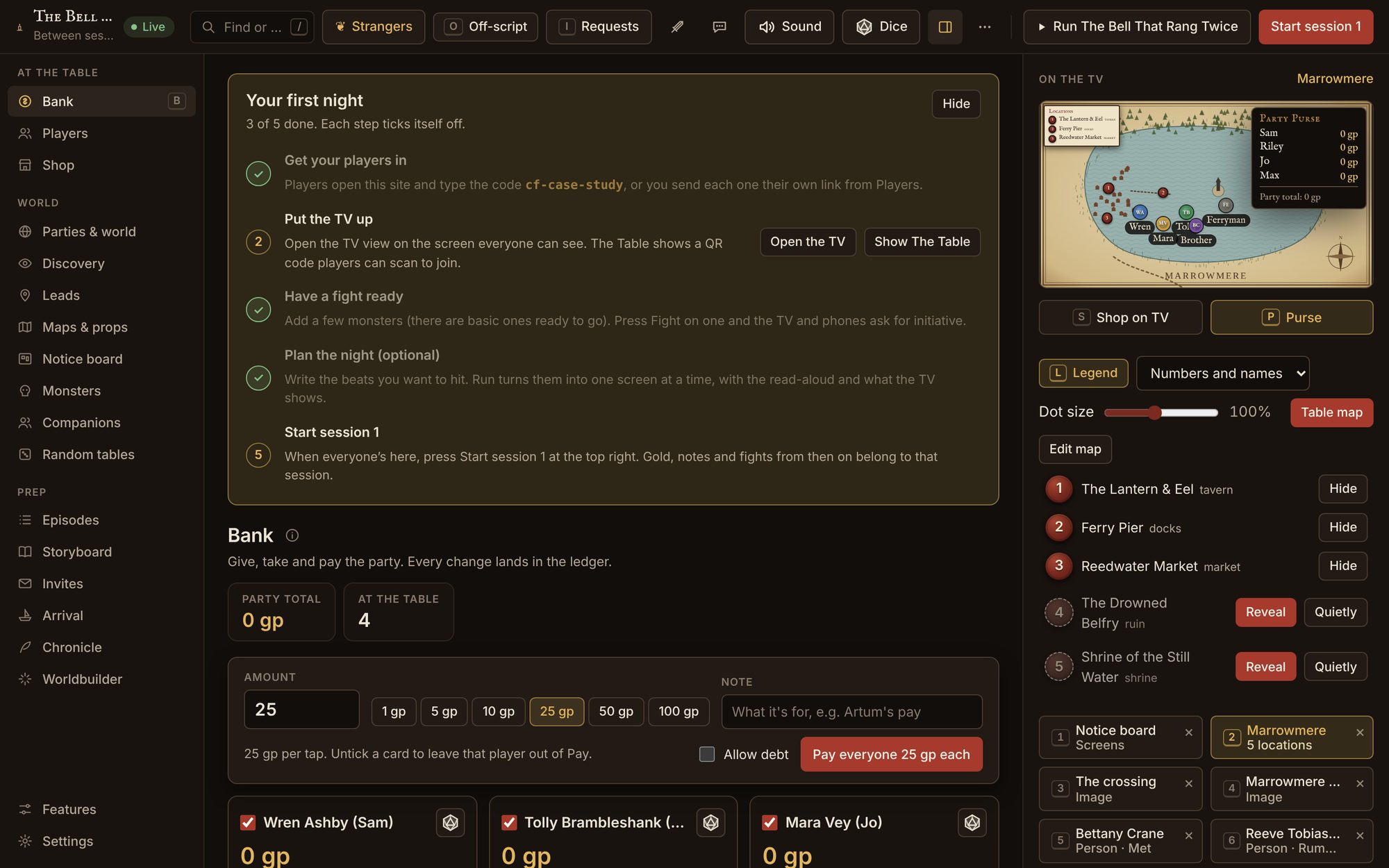
It's also shaped around how I want to run my world. My best friend can play about once a month, so several groups share one world and one storyline. Dungeon Garden keeps track of what each group has found and been paid, so the world stays consistent between them.
A second place gets a second copy
The usual answer to “another city wants this” is to add a city picker to one big site. madtown.today goes the other way. The same code can be built as a different city's site, chosen when it's built, and each city has its own config: its name, its copy, its games' local names, its puzzles and its questions. medcity.today, for Rochester, Minnesota, is being built this way.
export const madtown: CityConfig = {
  id: "madtown",
  site: {
    name: "madtown.today",
    tagline: "a homepage for the isthmus",
    cityName: "Madison",
    region: "Madison, WI",
    motto: "77 square miles surrounded by reality",
    // …
  },
  // …
};
The plan for this gives each city its own production database, so a bug in one city can't touch another's data, and keeps every key Madison already uses exactly as it is, so no one's streak resets. Each city keeps its own voice and its own content. What they share is code.
Dungeon Garden does the same thing at a smaller size. Every D&D group gets its own room: its own small server and its own storage, named by its campaign code. Nothing is shared between groups except the code that runs them. A group that stops playing for 180 days is cleaned up, and nobody else notices.
Why copies beat a platform here
- Local stays local. Rochester's puzzles don't have to make sense in Madison, and one group's house rules don't leak into another's game.
- Failures stay small. A bad day in one city or one group stays there.
- Each copy stays cheap. A copy sized to one community has a bill sized to one community.
- Someone local can own it. A city's site can have its own people choosing what goes on it, which a global platform can't offer.
The cost is upkeep. A second city is a second set of puzzles, events and moderation, and it only works if someone cares about that city. I think that's the right price: software for a place should be looked after by people who know the place.